Most people know their Sun sign — but your natal chart is the full story astrology has been trying to tell you all along. It is a precise map of exactly where every planet in the solar system was positioned the moment you took your first breath, and it reveals far more about who you are than a single zodiac sign ever could.
Think of it this way: your Sun sign tells you the genre of your life story. Your natal chart gives you every character, every plot thread, and every theme — all at once. If you have ever felt like generic horoscopes never quite fit you, this is exactly why. A natal chart is personal in a way nothing else in astrology is.
Before we go deeper, here are 5 things every beginner must understand about natal charts:
Your exact birth time matters more than you think. Even a 4-minute difference can shift your Rising Sign and change the house positions of your planets. Always try to find your accurate birth time from a birth certificate or hospital record.
A natal chart has three core layers — planets, signs, and houses. Planets show what energy is operating in your life. Signs show how that energy expresses itself. Houses show which area of life that energy lands in. All three work together; none can be read alone.
Your chart never changes. Unlike daily horoscopes or transits, your natal chart is fixed from birth. It is your permanent cosmic blueprint — a snapshot of the sky that belongs only to you.
No two natal charts are identical. Even twins born minutes apart can have meaningfully different charts. This is what makes a natal chart genuinely personal rather than generically astrological.
You do not need to memorize anything to get started. A good natal chart calculator does the calculation instantly. Your only job is to learn what the symbols mean — and this guide will walk you through exactly that.
What Exactly Is a Natal Chart?
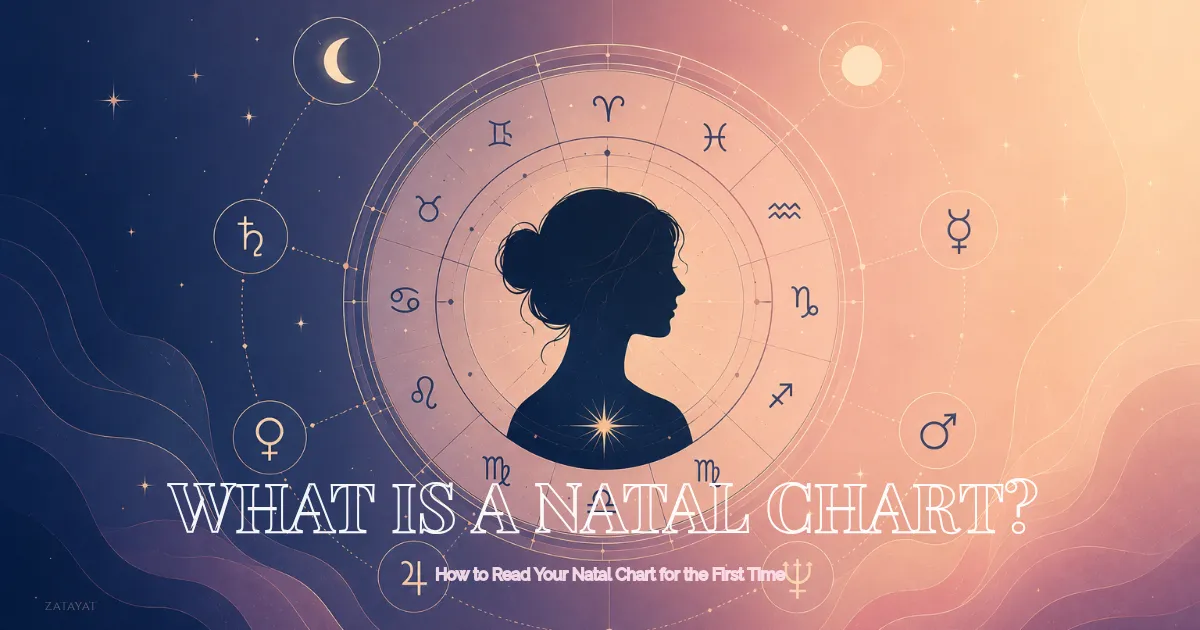
A natal chart — also called a birth chart or horoscope chart — is a circular diagram that maps the positions of the Sun, Moon, and all ten planets at the exact moment and location of your birth. The circle is divided into twelve segments called houses, and the band of zodiac signs runs around the outer edge. Every planet falls somewhere inside this wheel, sitting in a specific sign and a specific house.
The word "natal" simply means "of or relating to birth." So a natal chart is, literally, your birth map. Ancient astrologers believed that the arrangement of the sky at the moment of your birth created an energetic imprint that would influence your character, instincts, and life experiences. Modern astrology carries this same idea forward but frames it less as fate and more as self-awareness — a language for understanding patterns in who you are.
What makes a natal chart powerful is the combination of elements, not any single placement. Your Sun might be in Scorpio, but if your Moon is in Gemini and your Ascendant is in Aquarius, the way that Scorpio energy expresses itself is completely different from someone with the same Sun sign but different house and Moon placements. The chart is an ecosystem, and every part of it affects every other part.
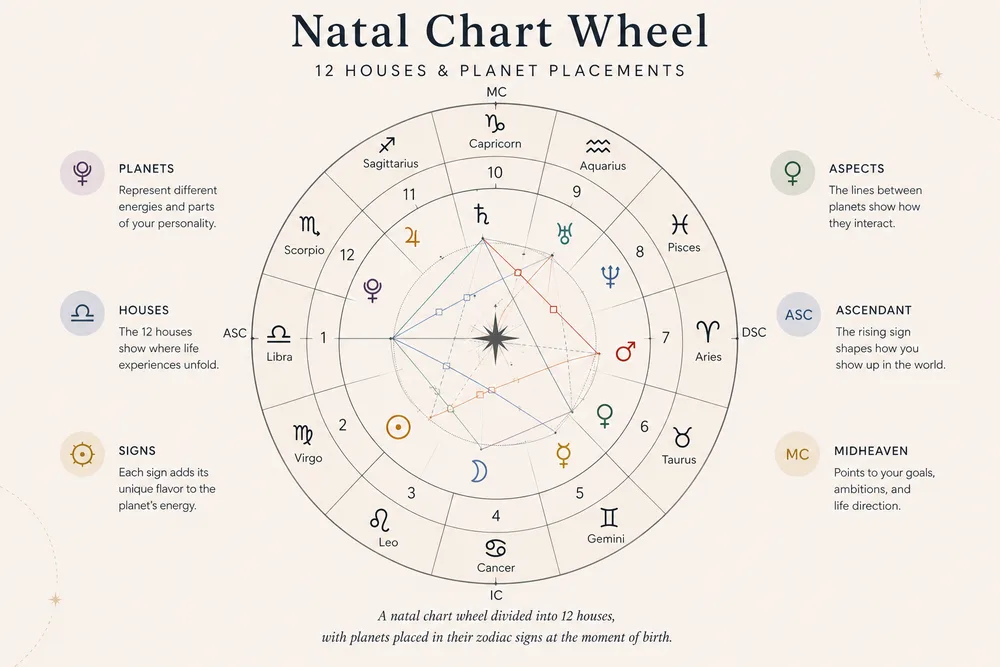 A natal chart wheel divided into 12 houses, with planets placed in their zodiac signs at the moment of birth.
The Difference Between a Natal Chart and a Daily Horoscope
Daily horoscopes are written for twelve groups of people — one per Sun sign. They are broad, generalized, and based only on where the Sun was when you were born. A natal chart, by contrast, is calculated using your precise birth date, birth time, and birth location. It accounts for all ten celestial bodies, twelve houses, and the geometric angles between planets called aspects.
In practical terms: a daily horoscope for Aries says the same thing to every person born between March 21 and April 19. Your natal chart says something unique to you and only you — and it never changes regardless of what day you read it.
Natal Chart vs. Birth Chart: Are They the Same Thing?
Yes — completely. The terms natal chart, birth chart, astrological chart, and natal horoscope all refer to the exact same diagram. Different astrologers and platforms use different terminology, but the underlying calculation is identical. On NatalZone, we use "natal chart" consistently because it best reflects what the chart truly is: a map drawn at the natal (birth) moment.
The Three Core Building Blocks of Your Natal Chart
Every natal chart is built from three interlocking layers that work together to create the full picture of who you are. Understanding these three elements is the single most important foundation for reading any chart. Once you grasp how planets, signs, and houses interact, the rest of astrology starts to click naturally.
Think of the planets as the actors in a play, the signs as the costumes and personality they wear, and the houses as the stage sets — the specific scenes where each act of your life unfolds. A planet in Aries in the 7th house behaves very differently than the same planet in Aries in the 1st house, even though the sign is identical.
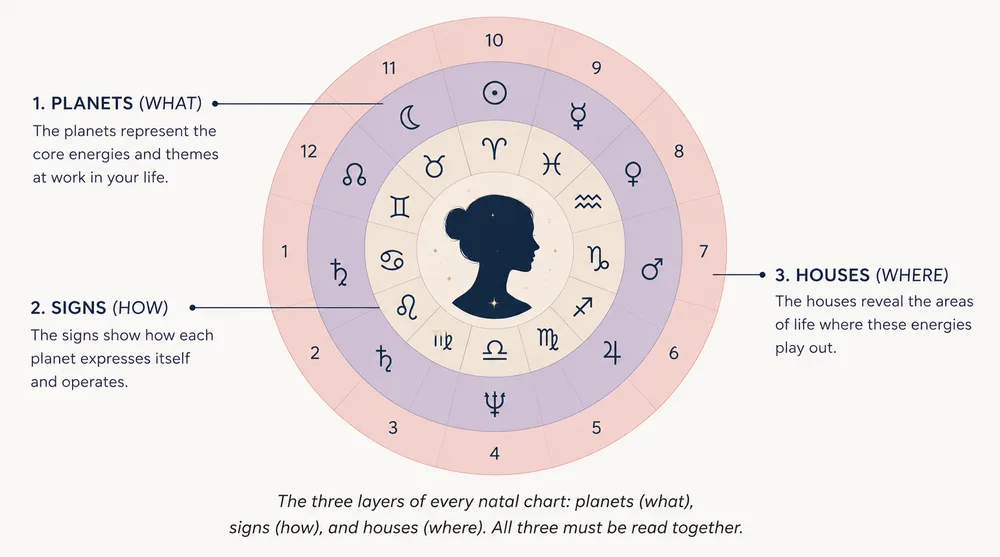 The three layers of every natal chart: planets (what), signs (how), and houses (where). All three must be read together.
The Planets: The What and Why
In astrology, "planets" include the Sun, the Moon, Mercury, Venus, Mars, Jupiter, Saturn, Uranus, Neptune, and Pluto. Each one represents a specific psychological function or drive operating in your personality.
The Sun governs your core identity and conscious will — the self you are growing into. The Moon governs your emotional instincts, needs, and subconscious patterns — how you feel before you think. Mercury rules how your mind processes and communicates. Venus rules how you love, what you value, and what attracts you. Mars rules how you act, fight, and pursue what you want. Jupiter rules where you expand and find luck. Saturn rules where you face discipline and build lasting structures. Uranus, Neptune, and Pluto are generational planets that work at a deeper collective level, but their house placement in your chart makes them personal.
The Zodiac Signs: The How
The twelve zodiac signs — Aries through Pisces — color the planets that sit within them. A planet in Aries acts with urgency, directness, and courage. The same planet in Libra acts with diplomacy, indecision, and a need for balance. Signs are filters that shape how a planet's energy expresses itself in your life.
This is why knowing only your Sun sign gives you just one twelfth of the picture. Every planet in your chart sits in its own sign. Your Moon might be in Taurus while your Venus is in Sagittarius and your Mars is in Capricorn — each with its own flavor and mode of expression.
The Twelve Houses: The Where
The twelve houses represent twelve different areas of life. The 1st House is the self and physical appearance. The 2nd governs money and values. The 3rd rules communication and siblings. The 4th covers home and family roots. The 5th rules creativity, romance, and children. The 6th governs health and daily work. The 7th covers partnerships and marriage. The 8th rules shared resources, transformation, and death. The 9th governs philosophy, travel, and higher education. The 10th — called the Midheaven — rules career and public reputation. The 11th covers friendships and social groups. The 12th governs the subconscious, hidden matters, and spiritual retreat.
When a planet lands in a house, it activates that life area with its particular energy. Mars in the 10th house, for example, suggests someone driven, competitive, and assertive in their career. Venus in the 4th house suggests someone who finds deep comfort and beauty in their home environment.
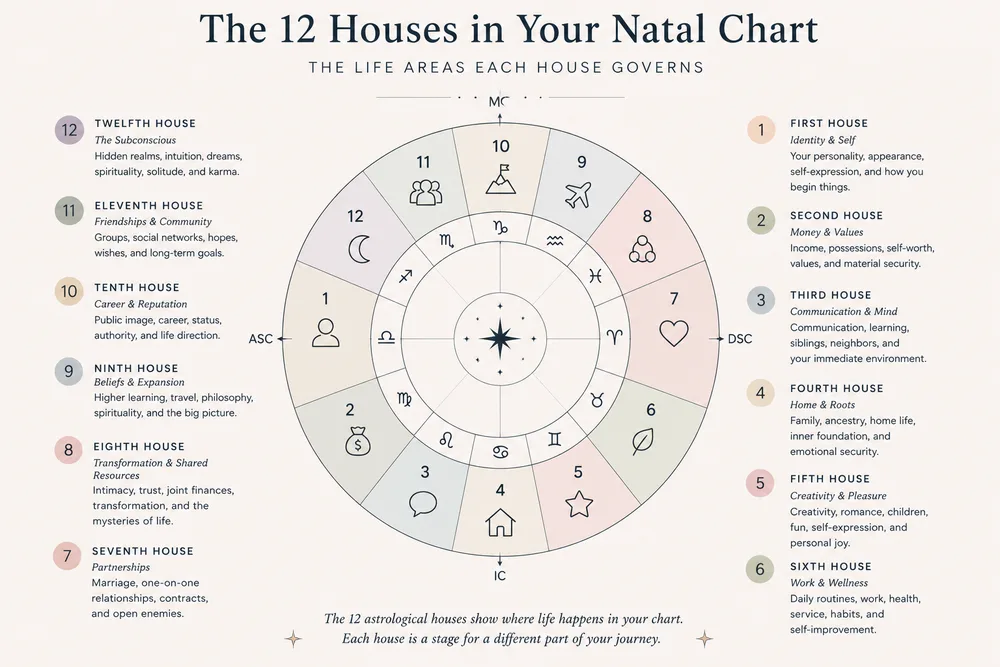 The 12 astrological houses and the life areas each one governs — from identity and money to career and the subconscious.
Your Big Three: Sun, Moon, and Rising Sign
When astrologers talk about the "Big Three," they mean the three most dominant and personality-shaping placements in any natal chart. These are your Sun sign, your Moon sign, and your Rising sign (also called the Ascendant). Together, these three placements form the core of who you are, how you feel, and how the world sees you.
Most people know their Sun sign from basic horoscopes. Far fewer know their Moon sign. And many people have never heard of their Rising sign at all — yet the Rising sign is arguably the most important of the three for understanding your outward personality and the structure of your entire chart. The good news: our free natal chart calculator reveals all three instantly.
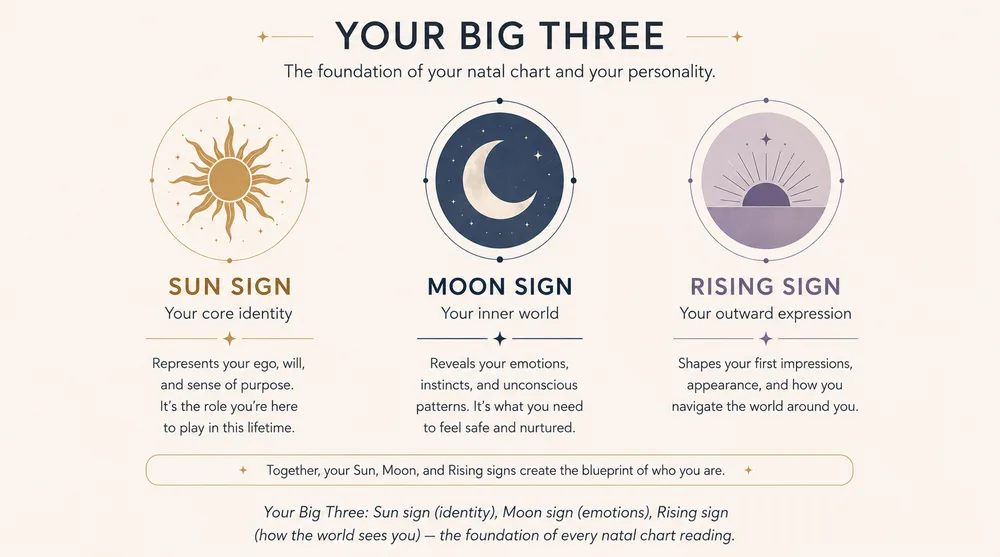 Your Big Three: Sun sign (identity), Moon sign (emotions), Rising sign (how the world sees you) — the foundation of every natal chart reading.
Sun Sign: Your Core Identity
The Sun in your natal chart represents your conscious self — the person you are actively becoming throughout your life. It governs your willpower, your sense of purpose, and the qualities you are here to develop and express. Your Sun sign is determined by the date you were born, which is why it is the one placement everyone already knows.
If your Sun is in Virgo, you are likely driven by a need to be useful, precise, and of service. If your Sun is in Leo, you are driven by a need for self-expression, recognition, and creative output. The Sun sign describes your life's central theme — the role the universe cast you in for this lifetime.
Moon Sign: Your Emotional Inner World
The Moon in your natal chart governs your emotional instincts, your subconscious reactions, your habits, and what you need to feel safe and secure. Unlike your Sun sign, which is about who you are becoming, your Moon sign is about who you already are at the deepest level — the self that shows up when no one is watching.
Your Moon sign changes every 2.5 days, which means it requires your birth date and birth year to calculate accurately. Two people born in the same week can have completely different Moon signs. A Scorpio Sun with an Aquarius Moon feels and processes emotions very differently from a Scorpio Sun with a Cancer Moon — even though they share the same outward Sun-sign archetype.
Rising Sign (Ascendant): How the World Sees You
Your Rising sign — the zodiac sign that was rising on the eastern horizon at the exact moment you were born — is the mask you wear in the world. It governs your physical appearance, your instinctive first reactions, the way strangers perceive you, and the overall lens through which you experience life.
The Rising sign changes every two hours, which is why your exact birth time is so critical for an accurate natal chart. This is also why two people born on the same day but at different times can seem like completely different personality types. The Rising sign sets the entire house system of your chart, making it the architectural foundation of your natal chart reading. Use our free natal chart calculator to find your exact Rising sign instantly.
How a Natal Chart Is Calculated
Calculating a natal chart from scratch was once the work of professional astrologers who spent hours consulting ephemerides — astronomical tables that recorded planetary positions across centuries. Today, a natal chart calculator does all of this work in seconds, applying the same precise astronomical data that traditional astrologers used, with zero manual effort required from you.
The calculation has two components: astronomical and geometric. First, the calculator uses your birth date, time, and location to determine the exact longitude of each planet in the solar system at that moment. Then it applies a house system — most commonly Placidus or Whole Sign — to project those planetary positions onto the circular chart wheel divided into twelve houses. The result is your unique natal chart.
What Information You Need to Generate Your Chart
To generate an accurate natal chart, you need three pieces of data: your date of birth (day, month, year), your exact time of birth, and your place of birth (city and country). The date tells the calculator the Sun's position and most planetary positions. The time determines your Rising sign and house cusps. The place adjusts for your geographic position on Earth, which affects house calculations because the sky looks different from different locations at the same moment.
If you do not know your birth time, you can still generate a chart using a "noon chart" — setting birth time to 12:00 PM — but your Rising sign and house placements will be unreliable. For most people, the best source for birth time is a physical birth certificate or hospital records.
House Systems: Placidus vs. Whole Sign
A "house system" is the mathematical method used to divide the sky into twelve house sectors. The most widely used system worldwide is Placidus, which divides the sky based on the time it takes for a degree of the ecliptic to rise, culminate, and set. Whole Sign houses assign one entire zodiac sign to each house, making it simpler and favored by traditional and Hellenistic astrologers.
The choice of house system does not change your planetary sign placements — your Sun will still be in the same sign regardless. It only affects which house each planet occupies. Neither system is objectively more correct; they reflect different philosophical traditions in astrological history. Try our natal chart calculator to generate your full chart now.
Planet Glyphs in Your Natal Chart: A Quick Reference
One of the first things that confuses beginners when they look at their natal chart is the symbols scattered across the wheel. These are called glyphs — shorthand symbols that astrologers use to represent each planet and zodiac sign. Learning to recognize them quickly turns a confusing diagram into a readable map.
You do not need to memorize all of them on day one. Focus on the ten planetary glyphs first, since those are what you will encounter most in any natal chart. Once you can identify each planet by its symbol, reading your chart goes from frustrating to genuinely enjoyable — and every placement suddenly becomes a story you can follow.
The Ten Planetary Glyphs at a Glance
- ☉ Sun — A circle with a dot at its center. Represents the core self, ego, and conscious identity.
- ☽ Moon — A crescent shape. Represents emotions, instincts, and the inner life.
- ☿ Mercury — A circle topped with a cross and two small horns. Represents the mind, communication, and thinking.
- ♀ Venus — A circle over a cross (the classic female symbol). Represents love, beauty, values, and attraction.
- ♂ Mars — A circle with an arrow pointing up-right (the classic male symbol). Represents drive, action, and desire.
- ♃ Jupiter — Resembles the number 4 with a horizontal bar. Represents expansion, luck, and abundance.
- ♄ Saturn — A cross over a curved hook, like a stylized lowercase h. Represents discipline, restriction, and long-term mastery.
- ♅ Uranus — An H shape with a circle at the base. Represents rebellion, sudden change, and originality.
- ♆ Neptune — A trident with a cross at the base. Represents spirituality, illusion, and imagination.
- ♇ Pluto — A P and L merged, or a circle over a crescent over a cross. Represents transformation, power, and deep change.
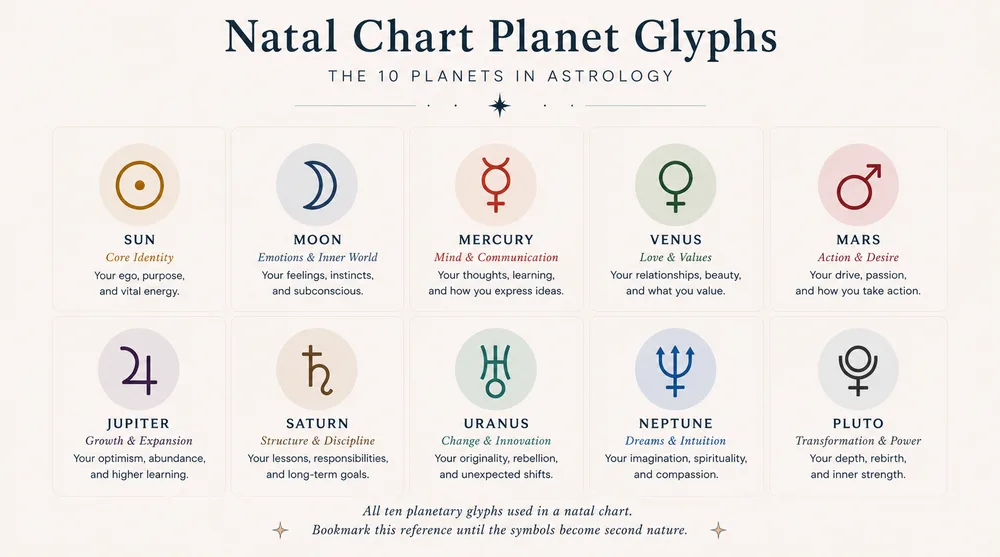 All ten planetary glyphs used in a natal chart. Bookmark this reference until the symbols become second nature.
Zodiac Sign Glyphs: Recognizing the Twelve Signs
Every natal chart also displays zodiac sign glyphs along the outer ring of the wheel, marking where each sign begins. Aries (♈) looks like a ram's horns. Taurus (♉) is a circle with two curved horns. Gemini (♊) shows two vertical lines connected by top and bottom bars. Cancer (♋) resembles a sideways 69. Leo (♌) is a circle with a curving tail. Virgo (♍) looks like an M with a looped tail. Libra (♎) shows a horizontal line with a bump above. Scorpio (♏) is an M with an arrow tail. Sagittarius (♐) is an arrow pointing up-right. Capricorn (♑) resembles a V with a looping tail. Aquarius (♒) shows two wavy lines. Pisces (♓) shows two vertical curved lines connected by a horizontal bar.
Aspects: The Lines Drawn Between Planets
Inside the natal chart wheel, you will notice colored lines criss-crossing the center connecting different planets to each other. These lines represent aspects — geometric angles between two planets that create a relationship between their energies. A trine (120°) shows planets in easy, flowing harmony. A square (90°) shows tension and challenge that drives growth. An opposition (180°) shows two planets pulling in opposite directions, requiring integration. A conjunction (0°) shows two planets in the same place, blending their energies powerfully. A sextile (60°) shows opportunity and supportive connection.
Reading aspects is an intermediate skill, but knowing they exist helps you understand why your chart is not just a list of isolated planet-sign-house combinations — it is a living web of relationships where every planet influences every other.
Common Natal Chart Mistakes Beginners Make
Learning to read a natal chart is genuinely rewarding, but beginners consistently fall into several predictable traps that create frustration or lead to inaccurate self-interpretation. Knowing these mistakes in advance will save you significant time and prevent the kind of misreading that puts people off astrology entirely.
Every one of these mistakes is easy to correct once you know it exists. Most of them come from reading placements as isolated keywords rather than as parts of an interconnected whole — which is exactly what a natal chart is designed to show you.
Mistake 1 — Reducing Yourself to Your Sun Sign
This is the single most common error in popular astrology. Many people read about their Sun sign, find that it does not fully resonate, and conclude that "astrology doesn't work for me." In reality, your Sun sign is one data point in a chart that contains dozens. Someone with a Sagittarius Sun, Virgo Moon, and Capricorn Rising will behave very differently from the typical Sagittarius archetype — and that difference is exactly what the full natal chart explains.
If you have ever felt that your Sun sign description doesn't fit, do not dismiss astrology. Generate your full natal chart and read your Rising sign and Moon sign descriptions. For many people, those two placements feel far more accurate and personal than the Sun sign alone.
Mistake 2 — Using an Incorrect Birth Time
An estimated or wrong birth time produces an inaccurate Rising sign and incorrect house placements. Since the Rising sign changes every two hours, even a one-hour error can shift your entire house system. This is why charts generated with an unknown birth time must be read with caution — any house-based interpretation becomes unreliable and potentially misleading.
Always verify your birth time from a birth certificate before trusting Rising sign and house placement readings. If your birth certificate is unavailable, an experienced astrologer can use a technique called "rectification" — estimating your birth time from key life events — to arrive at a reliable result.
Mistake 3 — Reading Placements in Isolation
A planet in Aries means aggression and impulsiveness, right? Not necessarily. If that planet is Saturn (which restricts and disciplines), sitting in the 12th house (hidden, private), and forming a harmonious trine with Venus, the overall expression of that "Aries energy" is far more measured and internalized than the raw archetype suggests. No placement exists in a vacuum.
This is why cookiecutter interpretations — reading each placement as a standalone keyword — often fail to capture the real nuance of a chart. The natal chart is a living system of relationships between its parts, and every meaningful interpretation must account for the full context surrounding each placement.
How to Use Your Natal Chart in Real Life
A natal chart is not just a fascinating personality portrait — it is a practical tool for self-awareness that can meaningfully inform your decisions, relationships, and personal growth. The most useful way to approach your chart is not as a set of fixed predictions, but as a map of your natural tendencies, your genuine strengths, and the areas where growth will require the most conscious effort from you.
People who work with their natal charts regularly report that it improves their understanding of why they react the way they do in close relationships, why certain career paths feel deeply aligned while others feel draining, and why specific life lessons seem to keep returning no matter how many times they try to move past them. The chart does not tell you what will happen — it shows you the terrain you are working with.
Natal Charts in Relationships
Comparing two people's natal charts — a technique called synastry — reveals the energetic dynamics between them. Certain planetary connections create immediate chemistry and deep mutual understanding; others create friction and growth through challenge. Understanding where your chart and another person's chart connect, overlap, or conflict gives you extraordinary insight into the underlying mechanics of any relationship, whether romantic, familial, or professional.
Even without formal synastry, knowing your own Venus and Mars placements — which govern how you love and how you pursue — can help you understand patterns in your romantic history with far more clarity and compassion than generic relationship advice ever could.
Natal Charts and Career Guidance
Your 10th house (the Midheaven) and the planets within or aspecting it describe your natural path toward career fulfillment and public recognition. Your 6th house shows how you function best in daily work environments. Saturn's placement in your chart reveals the area of life where you are being asked to build disciplined, long-term mastery. Together, these placements paint a nuanced picture of what kinds of work will energize you — and which will quietly drain you over time.
Many people find that their chart confirms what they have always sensed intuitively: that a certain kind of work feels deeply right while others, no matter how logical on paper, never feel sustainable. The natal chart gives that intuition a precise astrological vocabulary.
Using Your Chart for Personal Growth
Every chart contains both gifts and challenges. The gifts appear as well-aspected planets, strong house placements, and signs where planets express naturally and powerfully. The challenges appear as difficult aspects, heavy Saturn placements, or planets in signs where their energy is restricted or distorted. Both are equally important.
Rather than seeing challenging placements as bad news, experienced astrologers read them as the precise areas where the most meaningful and lasting growth occurs. A person with Saturn in the 7th house is not "doomed in relationships" — they are someone who, through conscious work on commitment and boundaries, can build unusually deep and durable partnerships. The natal chart reveals the curriculum, not the verdict. Generate your free natal chart now and start reading the story the sky wrote for you the moment you were born.